Project Background Team Research Advanced Training Capacity Building News Gallery PT
Sustainable Coffee Production in Agroforestry Systems in Mozambique
A trilateral project between Mozambique, Brazil, and Portugal,
based on research, education, and community
The TriCafé project focuses on biodiversity conservation and human development, based on coffee production in an agroforestry system, the capitalization of ecosystem services (coffee, native trees, mushrooms, and carbon), and the circular economy (water, bioenergy, biogas, and biofertilizers).

It also aims to promote agribusiness, increasing the income and food security of rural families in the region by training the various stakeholders.

Conserving native biodiversity and producing specialty coffee.

Mitigate poverty and food insecurity.

Maximizing ecosystem services and promoting the circular economy.

Capacitate different Mozambican actors (farmers, technicians, students, and researchers).
Results
1st Phase of TriCafé
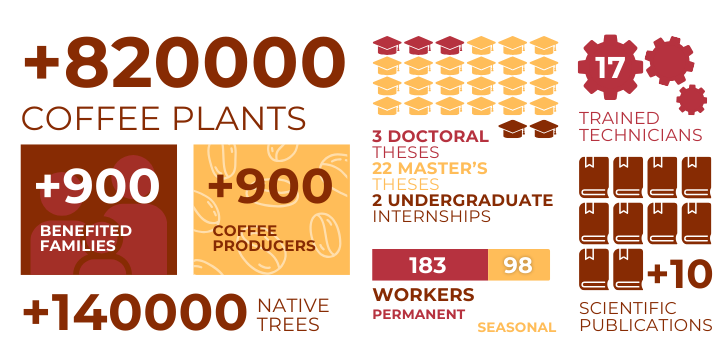

Another important outcome of the 1st Phase of TriCafé was the publication of a manual of good practices for coffee farming, focusing on key aspects such as procedures for managing and maintaining plants throughout the year, harvesting, processing, and storing coffee at the farmer level in Mozambique.
-
![]()
“I am very happy that my idea from a few years ago, which became the PNG team's desire to test the viability of producing coffee in the Gorongosa Mountains, is going well. Coffee from the slopes of the Gorongosa Mountains is contributing to the reforestation of the rainforest and providing employment for local farmers. And 100% of the coffee's revenues fund conservation and human development projects around the park!"
Pedro Muagura
-
![]()
“The search for alternative sources of income for communities living around parks and reserves challenges all biodiversity conservation leaders. And we believe that coffee cultivation is the solution for the Chimanimani landscape.”
Lionel Macicame
-
![]()
“A unique opportunity to conduct science for human development and biodiversity conservation, in a diverse sociocultural and scientific environment, from a North-South-South collaboration perspective, responding to the challenges of the United Nations 2030 Agenda and the EU-Africa Partnership.”
Ana Ribeiro
-
![]()
“For me, shade-grown coffee is more than just an agricultural practice. It is an integrated solution that links biodiversity conservation, climate action, and sustainable development. Above all, it is a bridge between nature conservation and human dignity.”
António Ngovene
-
![]()
“We have no doubt about the great contribution of science and research to improving productivity in a sustainable manner in all areas of knowledge. Therefore, this information and knowledge must reach those who need it, which is why training farmers is essential to making this activity more sustainable.”
Fábio Partelli
-
![]()
“The project is crucial for studying coffee production and quality, based on a strategy to mitigate the impacts of climate change. It also aims to restore the natural vegetation of the Gorongosa Mountains and all associated biodiversity, and to improve the quality of life of local communities involved in the coffee production chain.”
José Cochicho Ramalho
-
![]()
“This partnership has created numerous opportunities not only for me, but also for other colleagues. I personally had the opportunity to win a scholarship for my degree. Through this scholarship, we have had teachers from Portugal and Brazil and several coffee researchers, enabling us to exchange experiences and help improve our coffee production and productivity.”
Sional Moiane
-
![]()
“This project has generated a very strong cognitive component in me, that is, I perceive the production of knowledge as true wisdom, respecting and understanding the laws of nature with the inclusion of local knowledge.”
Crimildo Cassamo, student